Mr Marco Scarci's Clinical Approach to Thoracic Surgery
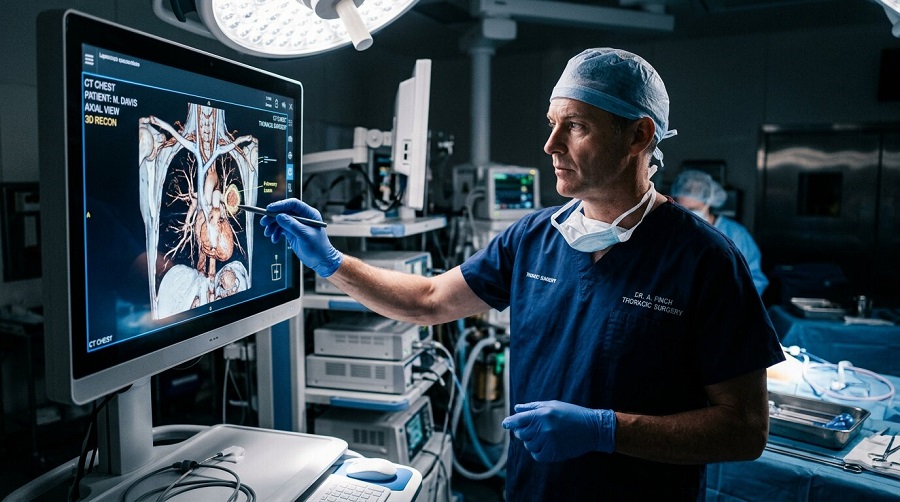
Thoracic surgery occupies one of the most technically demanding corners of medicine. Operations involving the lungs, chest wall, diaphragm, and mediastinum require not only surgical precision but also a high degree of clinical judgement, as outcomes can hinge on decisions made in real time. Within this demanding field, the quality of care is shaped as much by a surgeon's depth of expertise as by their ability to make complex information accessible and actionable for patients who are often navigating a serious diagnosis for the first time.
Mr Marco Scarci is a Consultant Thoracic Surgeon based in London, practising at several of the UK's most respected hospital institutions. With over two decades of experience and a portfolio spanning clinical surgery, academic research, and medical leadership, his work reflects a carefully developed approach to chest surgery. This review examines that approach in full, looking at his training and qualifications, the breadth of his clinical interests, his use of minimally invasive techniques, and the way his practice is structured around both patient outcomes and patient experience.
A Surgeon Shaped by Purpose
Mr Marco Scarci grew up in central Italy, where his early exposure to medicine came through a personal connection: his uncle was a cardiothoracic anaesthetist. That proximity to the specialty planted a professional direction that would eventually take him through medical training in Italy and Malta, followed by surgical rotations at the Essex Cardiothoracic Centre and at Guy's and St Thomas' Hospital in London. The formative years of his career were shaped by institutions with strong traditions in thoracic and cardiac surgery, providing a foundation that was both technically rigorous and clinically broad.
His specialist training was further refined through international fellowships at two of North America's leading surgical centres, the University of Toronto and McMaster University in Canada. These fellowships placed a particular emphasis on minimally invasive thoracic surgery, specifically Video-Assisted Thoracoscopic Surgery (VATS) and keyhole techniques, which would go on to become the defining thread of his surgical practice. This international exposure also informed his perspective on surgical education and the importance of cross-institutional learning, themes he has carried into his subsequent academic and leadership work.
Mr Scarci was appointed as a consultant in 2011, following which he has held positions at Royal Papworth Hospital in Cambridge, University College London Hospital (UCLH), and Imperial College Healthcare NHS Trust, with additional private practice at the Cromwell Hospital and Wellington Hospital through HCA Healthcare UK. The combination of NHS and private appointments reflects the breadth of his reach, allowing him to serve a wide patient population across different care settings. His career trajectory illustrates a consistent upward progression driven less by institutional advancement and more by a sustained commitment to clinical and academic excellence.
Specialties and Clinical Focus Areas
The clearest indicator of a surgeon's capabilities is the range of conditions they treat with consistency and depth. For Mr Scarci, lung cancer surgery represents one of the central pillars of his practice. He performs anatomical lung resections for both early-stage and more complex tumours, with the aim of achieving complete surgical clearance while minimising disruption to surrounding tissue. His use of minimally invasive approaches in this area has contributed to shorter hospital stays and faster recovery times for a significant number of patients.
Chest wall conditions form another substantial area of clinical focus. Mr Scarci has developed a recognised expertise in the assessment and surgical management of rib fractures, chest wall injuries, and slipping rib syndrome, as well as chest wall deformities including pectus conditions. He is acknowledged as an authority on pectus deformity repair, and his involvement in building the European Chest Wall Database reflects a level of engagement with this subspecialty that extends well beyond routine surgical practice. For patients with chest wall problems that have gone undiagnosed or untreated for extended periods, this depth of knowledge can make a considerable difference.
Pleural and mediastinal conditions also fall within his scope. He treats pneumothorax, commonly referred to as collapsed lung, using surgical techniques designed for both acute cases and recurrent presentations. In the mediastinum, he manages thymomas and other mediastinal tumours, which are conditions that require careful preoperative planning given their location and their relationship to surrounding structures. His role as chair of the European Society of Thoracic Surgeons (ESTS) chest wall and pleural disease working group indicates a level of professional investment in these areas that directly informs his day-to-day clinical decision-making.
Beyond these categories, Mr Scarci addresses functional disorders of the chest, including diaphragmatic paralysis, and holds a clinical interest in emphysema surgery and hyperhidrosis. This breadth across structural, oncological, functional, and deformity-based conditions is unusual for a single specialist and reflects a practice that has been built deliberately across the full spectrum of thoracic disease rather than narrowed into a single niche. Patients presenting with conditions that do not fit neatly into one category often find that this range of expertise is directly relevant to their care.
Advancing Minimally Invasive Thoracic Surgery
Minimally invasive surgery has transformed the landscape of thoracic procedures over the past two decades, and Mr Scarci has been an active participant in that evolution rather than a passive beneficiary of it. His fellowship training in VATS techniques set an early professional direction, and he has continued to develop his approach in line with the most current evidence and technique refinements. The majority of his surgical work is now performed through methods that avoid the need for large incisions, which carries meaningful implications for patient recovery, pain management, and overall comfort.
His adoption of the uniportal VATS approach, which involves operating through a single small incision rather than multiple ports, came after a direct visit to Dr Diego Gonzalez Rivas, one of the acknowledged pioneers of this technique. This willingness to seek out leading practitioners and incorporate their methods into his own practice speaks to an approach to professional development that is both collaborative and practically minded. He has also publicly advocated for greater publication of case data in the field, recognising that the evidence base for newer minimally invasive techniques must be continually strengthened if the specialty is to advance responsibly.
The clinical benefits of these approaches for patients are well established in the surgical literature. Reduced pain, shorter inpatient stays, lower complication rates, and faster returns to normal activity are consistently associated with minimally invasive thoracic procedures compared to open surgery. For patients who are already managing a demanding diagnosis, these factors are not merely technical considerations; they have a direct bearing on quality of life during and after treatment. Mr Scarci's commitment to refining and applying these techniques situates him firmly within the leading edge of contemporary thoracic practice.
A Multidisciplinary Approach to Patient Care
One of the features most clearly articulated in Mr Scarci's clinical philosophy is the importance of multidisciplinary collaboration. He works alongside a broad team that includes other surgeons, specialist nurses, radiologists, and respiratory physicians, with the goal of integrating each professional's perspective into the treatment plan for a given patient. This team-based structure is considered best practice in complex chest conditions, particularly where the interplay between imaging findings, pathology, and surgical planning requires input from multiple disciplines simultaneously.
His approach to care coordination extends beyond the operating theatre. He takes personal oversight of the tests, imaging referrals, and prescriptions required throughout a patient's journey, and underpins this with thorough Multi-Disciplinary Team (MDT) discussions at each key decision point. For conditions such as lung cancer, where the sequencing of surgery, oncological therapy, and follow-up imaging can be intricate, this coordinated oversight reduces the risk of delays or miscommunication between departments. It also means that patients are less likely to fall through the gaps that can emerge when clinical responsibility is distributed across multiple teams without clear coordination.
Mr Scarci also supports patients in navigating the administrative and logistical challenges that often accompany a surgical referral. This includes assistance with insurance approvals and negotiations, a service that patients seeking care through private channels often find unexpectedly difficult to manage independently. While this falls outside the strictly clinical dimension of a surgical practice, it reflects a recognition that barriers to accessing care can themselves affect outcomes, particularly where delays in treatment are clinically significant.
Shared decision-making is a stated priority at every stage of his practice. He works to ensure that patients understand their diagnosis, the available treatment options, and the reasoning behind any recommended course of action. This approach is consistent with the evidence that informed patients tend to report higher satisfaction, better adherence to postoperative guidance, and lower levels of preoperative anxiety. It also reflects an ethical orientation toward patient autonomy that aligns with contemporary standards in professional medical practice.
Academic Output and Professional Standing
Mr Scarci's academic output gives his clinical practice a dimension that extends well beyond individual patient encounters. He has authored or co-authored over 200 peer-reviewed articles in the field of chest surgery, a body of work covering topics ranging from surgical technique and outcomes data to clinical decision-making and the management of specific thoracic conditions. He has also published four books, which suggests not only a broad command of the literature but a sustained commitment to the documentation and communication of surgical knowledge over time.
He serves as an Associate Editor of the Journal of Thoracic Disease, one of the prominent international publications in his field. This editorial role places him within the academic governance of the specialty, providing influence over the direction of published research and the standards against which new clinical findings are assessed. Alongside this, he contributes to the UK National Institute for Health and Care Excellence (NICE) preoperative tests working group, which feeds into national clinical guidance and practice standards, indicating that his professional standing is recognised not only within surgical circles but also at a national policy level.
On the European stage, his work chairing the ESTS chest wall and pleural disease working group and leading the development of the European Chest Wall Database reflects a commitment to the kind of systematic, registry-based data collection that allows meaningful comparison of surgical outcomes across different techniques and centres. This type of infrastructure-building work may not be visible to individual patients, but it ultimately informs the standards of care available across the continent. His involvement at this level places him among those actively shaping the trajectory of his subspecialty rather than simply practising within it.
The Patient Experience: Communication and Support
The quality of a surgical consultation extends beyond technical discussion of a procedure. How a surgeon communicates, how responsive they are to patient concerns, and how they handle the uncertainty that inevitably accompanies a serious diagnosis are all factors that patients weigh alongside clinical credentials. Mr Scarci's approach in this area reflects a deliberate effort to make the care experience as clear and well-supported as possible, from the initial consultation through to postoperative recovery.
Direct access and timely responses are features that stand out in accounts of his practice. He maintains availability before, during, and after treatment, which is a notable commitment in a specialty where the interval between consultations can sometimes leave patients with unanswered questions about their condition or recovery. For patients managing a new or serious diagnosis, the ability to communicate directly with their surgeon rather than through intermediaries can significantly reduce anxiety and support better decision-making should unexpected developments arise.
The personal dimension of his approach to patient care is grounded, in part, in his own experience of the healthcare system as a family member. He has spoken about caring for his mother through medical treatment, an experience that shaped his understanding of what patients and their relatives need from their clinical team. This perspective appears to inform a practical attentiveness to how care is delivered, not just in terms of what decisions are made but how they are communicated and supported throughout.
It is worth noting that Mr Scarci's practice is based in London and that his schedule, given his combined NHS and private commitments, is in considerable demand. Patients located outside the capital or those requiring an urgent first appointment may need to factor in some lead time when seeking a consultation. That said, for those who are able to access his practice, the breadth of his clinical expertise, the structure of his patient care model, and the weight of his professional record make him a well-founded choice within thoracic surgery in the United Kingdom.
A Career Built on Rigour, Research, and Responsibility
Mr Marco Scarci represents a relatively uncommon combination in modern surgical practice: a clinician whose technical expertise is matched by a serious academic record and a genuinely patient-centred approach to care. His work across NHS and private institutions, his leadership within European thoracic surgery bodies, and his focus on minimally invasive techniques all speak to a practice that has been built with intention and maintained with consistent professional standards. For patients facing chest surgery, whether in the context of cancer, structural conditions, or functional disorders, the depth and organisation of his practice are factors worth careful consideration.